I'll be straight with you -I don't expect any recommended change to automatically become the way of working just because it's been announced and launched. Things tend to go well for the first couple of weeks, and then people drift back to their usual patterns.
That's not because they disagree with the change, or because they're trying to be difficult. It's simply because they're busy delivering for clients. Sometimes you just want to get the job done. Which is entirely human.
But if there was a genuine need for the change in the first place - a process gap, a quality issue, a compliance requirement - then people reverting to old habits means that problem comes back. Which means the change I promised to deliver hasn't actually been delivered.
I've also learned to manage expectations with stakeholders who assume that launching a new initiative means the job is done. In my experience, that is very rarely the case.
The cost of not embedding change
Failed initiatives are more expensive than most leaders realise. There's the obvious cost - the time spent designing the change, communicating it, training people. All of that investment evaporates if it doesn't stick.
But the hidden cost is worse. Every time a change initiative fails, people become a little more cynical. The next time you announce something new, the unspoken reaction around the room is "here we go again." You haven't just lost this initiative - you've made the next one harder to land before it's even started.
There's also the credibility cost. Leaders who repeatedly launch things that don't stick lose the trust of their teams. And in a agency, that trust is everything.
The original problem doesn't go away either. It just resurfaces - usually at the worst possible time.
The emotional side of change
People don't just resist change intellectually - they resist it emotionally. Change, even positive change, involves loss. Loss of familiarity, of status, of being the person who knows how things work. When you introduce a new process, you're implicitly telling someone that the way they've been doing it isn't good enough any more. Even if that's not your intention, it can feel that way.
Fear plays a role too. Fear of getting it wrong in front of colleagues. Fear of looking incompetent while learning something new. Fear of what the change might mean for their role longer term.
If you ignore the emotional side and focus purely on the practical - here's the new process, here's the training, off you go - you'll wonder why people aren't coming with you. Acknowledging it changes the dynamic entirely. Simply saying "I know this is a shift and it might feel uncomfortable at first" gives people permission to feel what they're feeling without it becoming resistance.
The most effective change leaders don't just manage the process. They pay attention to how people are experiencing it.
Start before the launch
One of the most important parts of embedding change is what you do before it's announced. I bring people in early - before the decision is finalised. That way they feel involved rather than informed. People are far more likely to follow a change they had a hand in shaping.
I never start with the solution. I start with the problem.
If people don't truly believe the change was necessary - if it feels like change for change's sake rather than fixing a problem that actually needed fixing - you'll never get genuine adoption. You'll only ever get people performing it. That's why before anything else, I make sure everyone agrees there's actually a problem worth solving. When people understand the why - really understand it - the how becomes much easier to embed.
Bringing people in early doesn't eliminate resistance, but it reduces it significantly. And it reduces the number of difficult conversations you'll need to have later.
Weekly one-to-ones
Once something is launched, I run weekly one-to-ones - half an hour each. That's where I get the real picture. Not just the data, but how people are actually feeling about the change, what's working and what isn't.
I deliberately choose one-to-ones over team meetings for this. In a group, people are guarded. In a room with just me, they're honest. The things that aren't working - the real blockers - only come out when it's a private conversation.
It sounds like a significant time commitment but at half an hour a week it's manageable, and it's where most of the embedding actually happens.
The difficult person
Let's be honest - even with the best will in the world, there is almost always one person who simply wants to do it their way. That's just human nature. And usually, everyone already knows who it is. They just don't say the name.
When I spot that person, I don't open with a challenge. I start casually - ask how they're getting on, what they think about the change, whether there's anything they'd do differently. That approach does two things. It gives them a chance to raise a legitimate concern, which is always worth hearing. And more often than not, it gives them the space to identify the issue themselves, which makes the conversation far more productive than if I'd walked in with a list of complaints.
If that conversation doesn't move things forward, I escalate to their line manager. But I try hard to avoid that. A direct conversation, handled well, is almost always the better outcome for everyone.
Compliance vs genuine adoption
There's an important distinction between someone who is going through the motions and someone who has genuinely bought in. Compliance tends to be fragile - it holds while a line manager is watching, and unravels the moment the pressure lifts.
But compliance is often a signal that something went wrong much earlier in the process. If people don't truly believe the change was necessary, you'll never get genuine adoption. You'll only ever get people performing it.
When people understand the why - really understand it - the how takes care of itself.
The role of the leader during implementation
The most common pattern I see is this: a leader puts enormous energy into designing and announcing a change, and then effectively disappears from it. They move on to the next thing. They assume the momentum from the launch will carry it through.
It won't.
The leaders who embed change successfully stay visible throughout the process. They show up in the check-ins. They ask questions. They notice when things are slipping and address it early rather than hoping it resolves itself.
But there's something even more fundamental. If you're asking your team to change the way they work, you have to be seen to be living it yourself. People watch leaders closely - far more closely than leaders realise. If you're not following the new process, why would anyone else?
Implementation is not a delegation job. It needs the leader in the room.
Common mistakes people make
After working with a number of agencies on this, the same patterns come up repeatedly.
Confusing the launch with the job
The announcement gets treated as the finish line. There's energy, communication, maybe a team meeting. And then nothing. No follow through, no check-ins, no accountability. The change quietly fades.
Assuming silence means agreement
People not pushing back doesn't mean they're on board. Often it just means they've learned that raising concerns doesn't change anything. Silence is not buy-in - it's just silence.
Not defining what success looks like
If you haven't decided upfront what the change is supposed to achieve and how you'll know when it's working, you have no basis for reviewing it. Vague initiatives produce vague outcomes.
Overloading people with change
Running three or four initiatives simultaneously means none of them get the attention they need to embed. People can only absorb so much change at once. Prioritise ruthlessly.
When is it done?
It's not when everyone is following the process. It's when they're doing it automatically - when it's just how things work here.
But the real test, for me, is what happens when someone new joins. If a new team member is told by their colleagues "this is how we do it here" - without any prompting from me - that's when I know it's done. You don't want new people being onboarded into old habits. When the team itself becomes the keeper of the new standard, that's genuine adoption.
Running an agency but feeling like it's running you?
If growth keeps stalling, margins stay flat and too many decisions still land on your desk, the problem usually isn't the work. It's the way the agency operates behind the scenes.
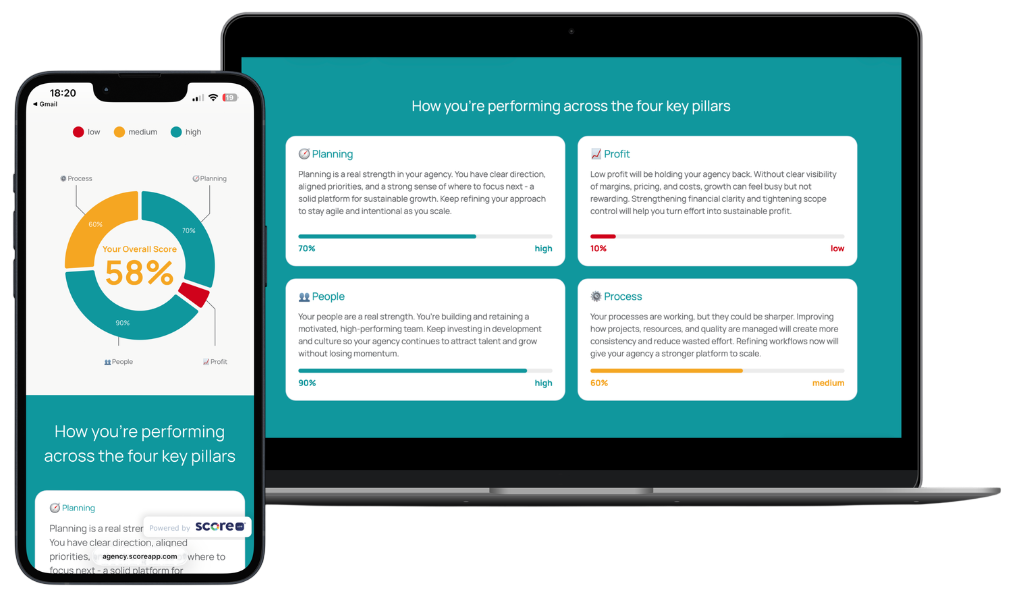
AgencyOS™ is a structured engagement that helps creative agencies identify and remove the operational barriers to profitable, scalable growth.
Through four pillars - Planning, Profit, People and Process - you'll get a prioritised roadmap and hands-on support to implement and embed the changes that matter most.
No vague recommendations. No slide decks that gather dust. Just clearer priorities, stronger accountability, smoother delivery and a business that can grow without relying on you for every decision.