Poor briefing is one of the most persistent and costly problems in agency life. It drives rework, erodes margin, and frustrates both sides of the client relationship. Yet after years of auditing agencies of different sizes, in different sectors, and at different stages of growth, I have never once completed an audit and been told: "Yes, briefing is something we've nailed." It's always on the list. And it probably always will be - unless agencies start treating it as something that needs proper process behind it.
Briefing failures are rarely about intent. Clients want good work, agencies want to deliver it. The problem is that most agencies don't treat briefing as a process that needs to be designed and enforced. It just happens - or doesn't - and nobody owns it.
The data makes uncomfortable reading
The BetterBriefs global study of over 1,700 marketers and agency staff across 70 countries, first published in October 2021 and followed by a UK-specific report with the IPA in 2022 - is the most comprehensive research ever done on this topic. You can find their full research at betterbriefs.com.
The findings are stark. 80% of marketers believe they are good at writing briefs. Only 10% of creative agencies agree. 78% of marketers believe their briefs provide clear strategic direction. Only 5% of creative agencies agree. And an estimated third of marketing budgets are wasted due to poor briefs and misdirected work.
The marketers responsible are not junior or inexperienced - the majority are senior, with over a decade of experience. This is not a skills gap. It is an industry-wide blind spot.
Why it keeps happening
The most common reason is that agencies are too eager to get started. When new work comes in, the instinct is to move - to show momentum, to get into the creative, to demonstrate value quickly. So the brief doesn't get interrogated. Questions that should be asked at the start get deferred or skipped entirely. And by the time the gaps become apparent, the work is already underway and changing direction is expensive.
A large part of this falls on account management. Account handlers are the people who receive the brief, and they are the ones who decide whether to interrogate it or simply pass it on. Too often it is the latter. The brief arrives, it looks close enough, and the pressure to get moving means nobody asks the questions that need to be asked. That is a process failure, but it is also a leadership failure - agencies need to give account managers both the permission and the expectation to push back.
And then there is the issue of verbal briefing becoming the norm as client relationships mature. Research from the IPA found that in practice half of all briefs delivered to agencies are verbal only - and this gets worse over time. New business briefs tend to follow the right process. Existing client briefs, where familiarity has set in, increasingly do not. Comfort breeds shortcuts.
The operational cost of a poor brief
Most agency leaders think about bad briefs as a creative problem - the work misses the mark, the client is disappointed, you go again. But from an operational standpoint, the damage runs much deeper than that.
Every unclear brief is a process failure waiting to happen. When the brief doesn't define the problem clearly, work gets started on the wrong foundation. Revisions multiply. Stakeholders who weren't in the original conversation suddenly have opinions. Deadlines slip.
The time spent correcting and redoing is time that was already allocated, already costed, already assumed to be productive. That's margin walking out the door.
Teams that regularly work from poor briefs also develop a quiet dread about new projects - because experience tells them it will go sideways. That erodes morale and over time contributes to the kind of burnout that costs agencies their best people.
Slow down to speed up
The time an agency thinks it is saving by moving quickly past the brief, it will spend several times over in rework, scope creep, and misdirected effort. A weak brief doesn't just produce weak work. It produces work that has to be done again.
I am not an expert in this area, and there are people far better placed than me to advise on how to construct a great brief. But I don't need to be an expert to recognise that rushing past it is one of the most reliably expensive decisions any agency can make.
From an operational standpoint, there are four things any agency can do regardless of size or sector.
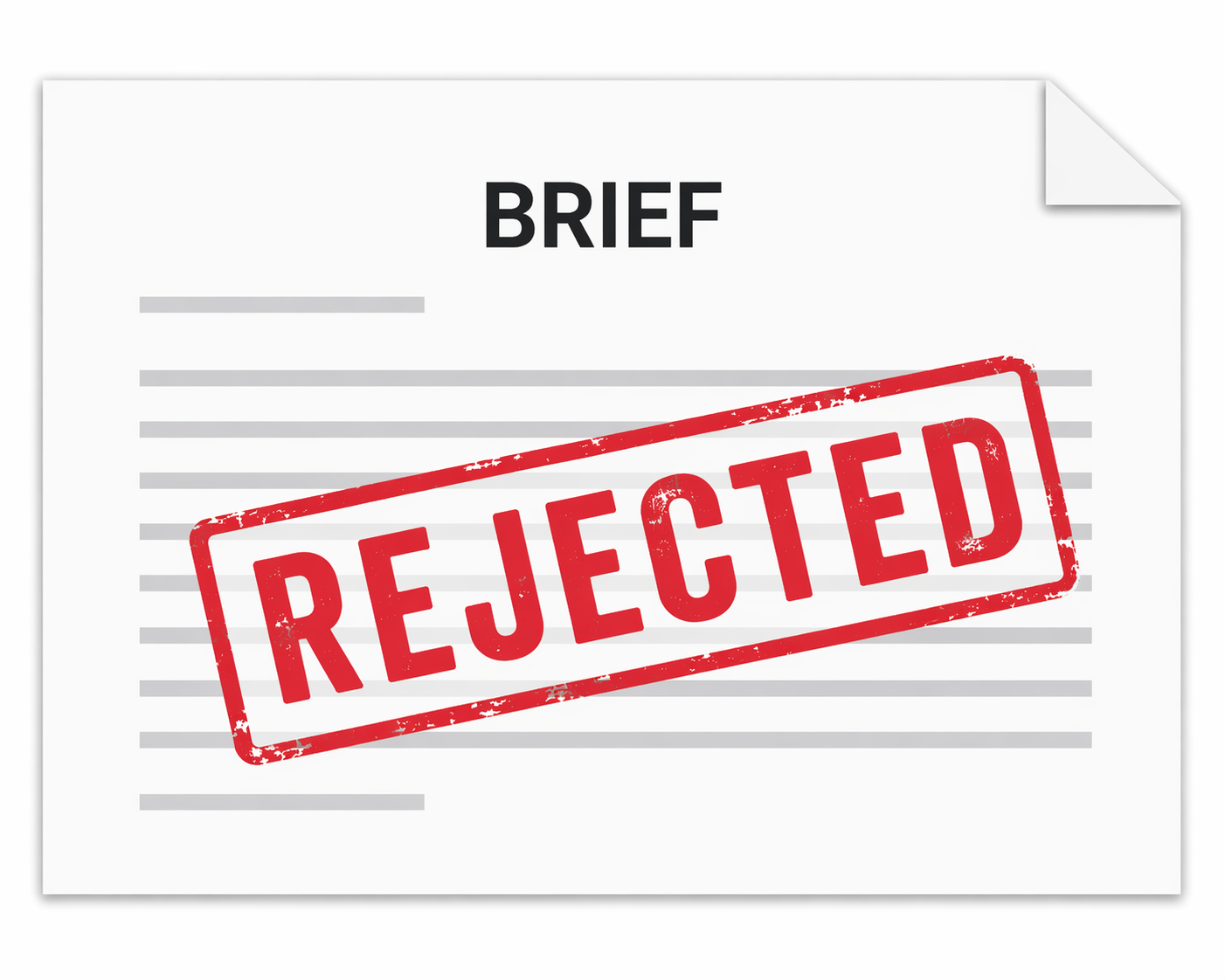
First, never start work without a written brief that both the agency and client have agreed. A phone call is not a brief.
Second, build a brief review stage into your creative workflow - a fixed point before creative work begins where the brief is checked against a simple set of criteria. Does it define the problem? Is the audience clear? Are the success criteria agreed? If the answer to any of those is no, the work does not start.
Third, consider co-writing the brief with the client rather than waiting for one to arrive. When both sides have built it together, the brief has shared ownership - and the risk of a fundamental change in direction later reduces significantly.
Fourth, introduce a formal sign-off on the brief before any work begins. This is something many agencies resist - it feels like it slows things down, and there is always pressure to just get started. But a brief that has been formally approved by the right people on the client side removes ambiguity, reduces the risk of late-stage changes, and gives the agency a clear point of reference if the goalposts start to move. The time it takes to get a signature is nothing compared to the time lost redoing work that was built on an unclear foundation.
The brief is not a formality before the process begins. It is the first gate in your creative workflow - and the agencies that manage it well have simply decided that it is worth the time, and they protect that time even when the pressure is to just get on with it.
The brief is about to get more complicated
There is also a conversation to be had about what artificial intelligence means for the briefing process - both the opportunities it presents and the risks it introduces.
On the surface, AI offers the prospect of faster, more structured briefs. But faster isn't always better, and there is a real question about whether AI makes it easier to paper over the gaps that cause problems in the first place. That is a topic I will be returning to in a future post.