Many agencies assume that if revenue grows, profit will naturally follow.
On the surface that assumption seems logical. Revenue increases, new clients are coming in and the team grows to support the expanding workload. From the outside, it can appear that the agency is moving in the right direction.
But when leadership teams look more closely at the numbers, a different picture often emerges. Revenue may have increased, yet profit hasn’t followed in the same way. In some cases, profit margins have even declined.
This is a pattern I see regularly when reviewing agency operations. Growth on its own doesn’t automatically translate into stronger profitability.
Revenue growth and agency profitability are not the same thing
Revenue growth and agency profitability are closely related, but they are not the same.
Many agencies grow revenue faster than they improve the way they operate. New clients are won, projects increase and teams become busier. However, the operational foundations required to deliver that work profitably do not always evolve at the same pace.
Pricing may not fully reflect the effort required to deliver the work. Scopes gradually expand as client expectations change. Teams absorb additional tasks to keep projects moving and maintain client relationships.
The result is an agency that looks successful on the surface but where profit margins become harder to maintain.
None of this is unusual in a growing agency. The challenge is that these changes often happen gradually, meaning the impact on profitability isn’t immediately visible.
What operational reviews often reveal inside agencies
When I review agency operations, similar patterns appear quite quickly.
Projects that looked profitable at the outset have quietly expanded in scope. Teams are working hard but not always focused on the most valuable work. Leadership teams often rely on instinct rather than operational visibility to understand where time and effort are really being spent.
At the same time, the business becomes more complex. More clients, more projects and larger teams increase the number of operational decisions that need to be made every day.
Without clear processes and visibility, it becomes increasingly difficult for leadership teams to maintain a clear view of performance.
Individually, none of these issues appear dramatic. Together, however, they often explain why revenue can grow while profit remains stubbornly flat.
Where agencies typically lose profitability
In most agencies, the gap between revenue and profit doesn’t sit in one obvious place. It usually appears across several operational areas at the same time.
Resource planning can become reactive rather than deliberate. Projects take longer to deliver than originally expected. Additional work is absorbed by the team rather than properly scoped and priced. In response to increasing pressure, agencies hire additional staff, only to find that utilisation drops and margins tighten.
Over time these small inefficiencies compound. What begins as manageable operational friction gradually erodes agency profit margins.
Why growth increases operational complexity
As agencies grow, the operating model inevitably becomes more complex.
There are more clients to serve, more projects to manage and more people involved in delivering the work. Information often becomes spread across multiple systems, reporting becomes fragmented and forecasting becomes harder.
Leadership teams spend more time reacting to delivery challenges rather than proactively managing performance.
Revenue can continue to rise in this environment, but the operational structures required to support profitable agency growth can start to weaken if they are not intentionally strengthened.
How profitable agencies operate differently
The agencies that successfully grow both revenue and profit tend to take a more deliberate approach to operations.
They understand how work flows through the agency - from pipeline and planning through to delivery, resourcing and financial performance. They maintain visibility over capacity, utilisation and project profitability, allowing leadership teams to make more informed decisions about pricing, resourcing and growth.
Operations in these agencies are not treated as a back-office function. Instead, they are recognised as a strategic capability that supports sustainable growth and stronger profit margins.
This is where clearer operations make the difference
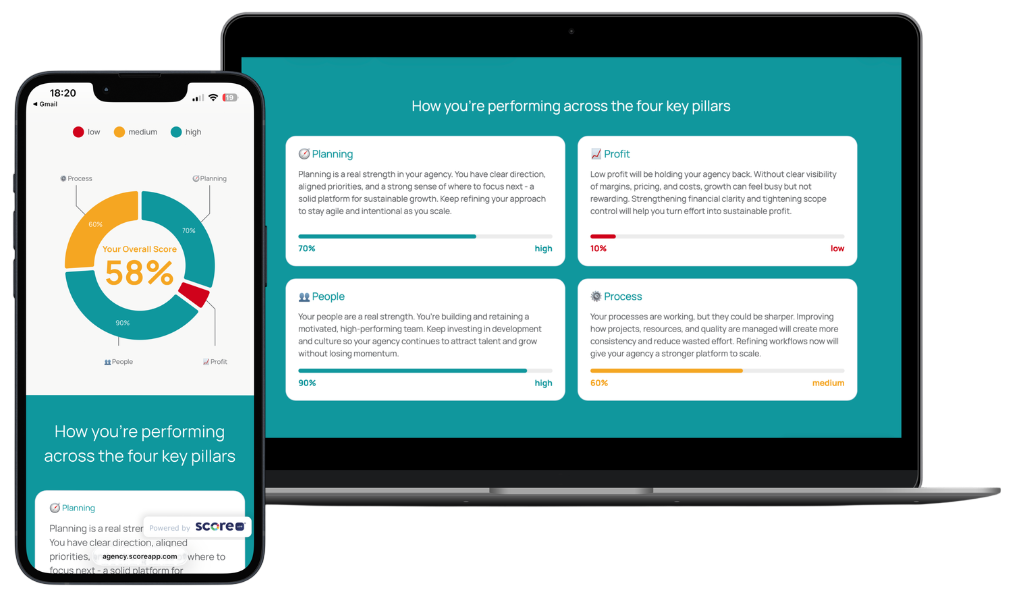
This is one of the reasons I developed the AgencyOS™ framework, which focuses on four areas that shape how an agency performs - planning, profit, people and process.
When these areas are aligned, leadership teams gain a clearer view of how their agency actually operates. That clarity makes it easier to identify profit leaks early and address them before they become structural issues.
Ultimately, growth on its own isn’t the goal - profitable growth is.
Want to understand where profit is leaking in your agency?
If revenue is growing but profit isn’t keeping pace, it’s often a sign that the operational foundations of the agency need attention.
Understanding where profit is being created - and where it may be leaking - requires a clear view across planning, pricing, delivery, resourcing and financial performance. For many agencies, these areas evolve gradually as the business grows, making it difficult for leadership teams to see the full picture.
Through my AgencyOS™, I work with founders and agency leadership teams to review how the agency actually operates. The goal is to identify the operational issues that are affecting profitability and create a practical roadmap for improvement.
If you’d like an external perspective on how your agency is running, you can start with the free Assessment or book a conversation to discuss your situation.